Sunday, March 6, 2011

Ghana Slide Show

Tomorrow morning I'm heading over to Poudre High School to give a presentation on Ghana.  I put together this slide show for the students, and I thought you all would enjoy seeing it as well.  Some of it may not make as much sense without my comments but I think you will like it nonetheless.  I apologize in advance if it takes a long time to load up the slide show, be patient and it will come up eventually.  I'm bringing props as well to the school but they're not in the slide show, obviously.  Perhaps I'll post my props in my next blog post.

I used to have this slide show presented as a google docs slide show, but it took a really long time to load, so I changed the post to simply display the slides from the show.


I tried to make the presentation interactive so we learned a few Twi  language phrases throughout.

Not surprisingly, no one in the class knew where Ghana was!


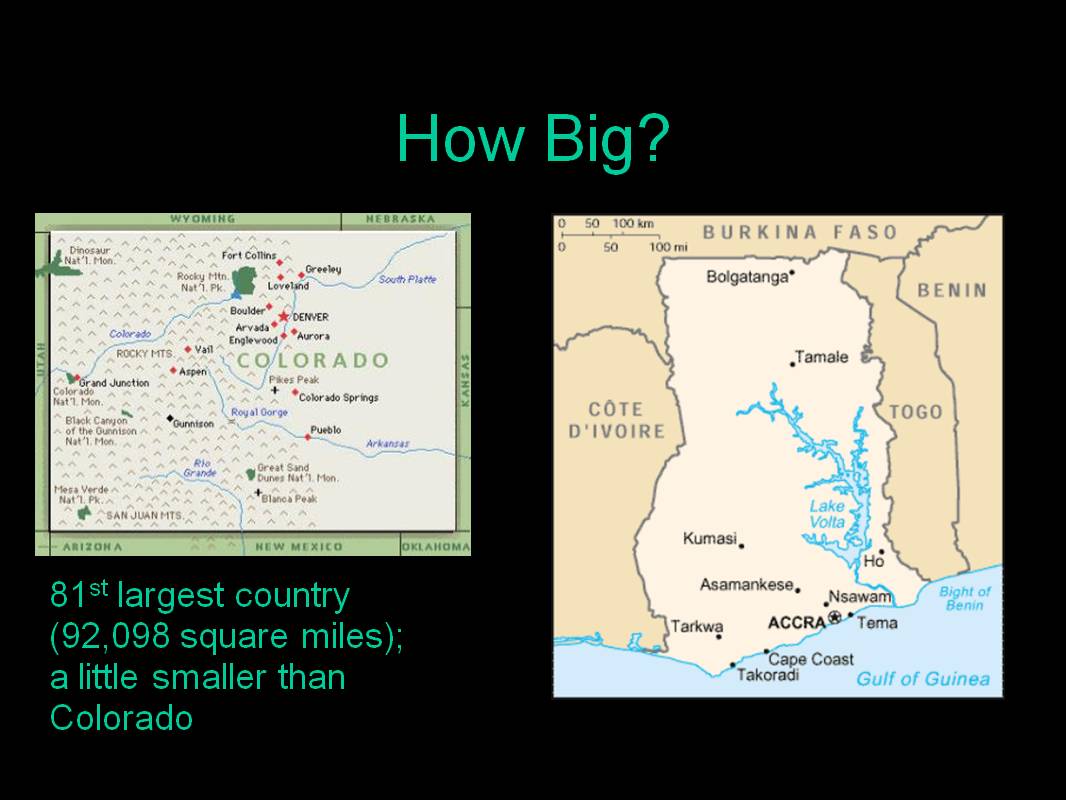
Since Ghana and Colorado are similar in size, this made for a handy comparison.


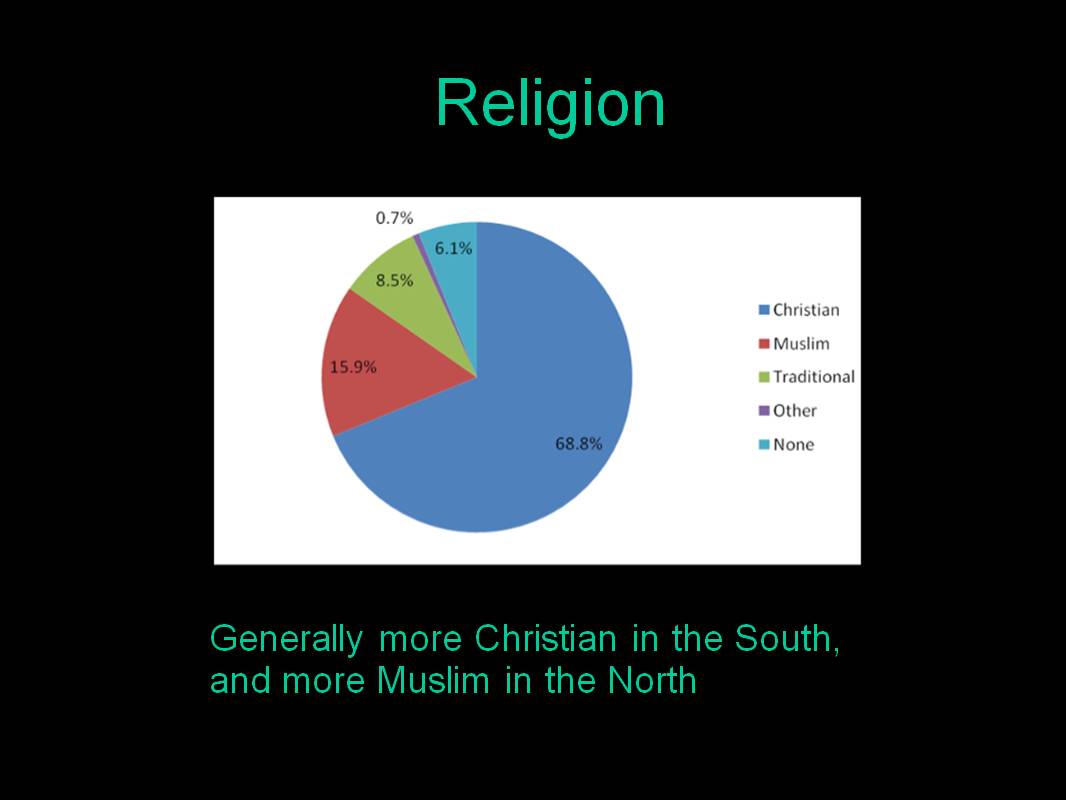
I mentioned that the Christians and Muslims seem to get along fairly well in Ghana.

A couple of people knew the day of the week they were born, but not many, so this bit was of limited value I think.


I did mention that there are issues with mining and timber production, but didn't get into things too deeply.


This was worth about one dollar when I was there, apparently it's worth about ten cents now, and Ghana is going to have a "new Cidi" soon.

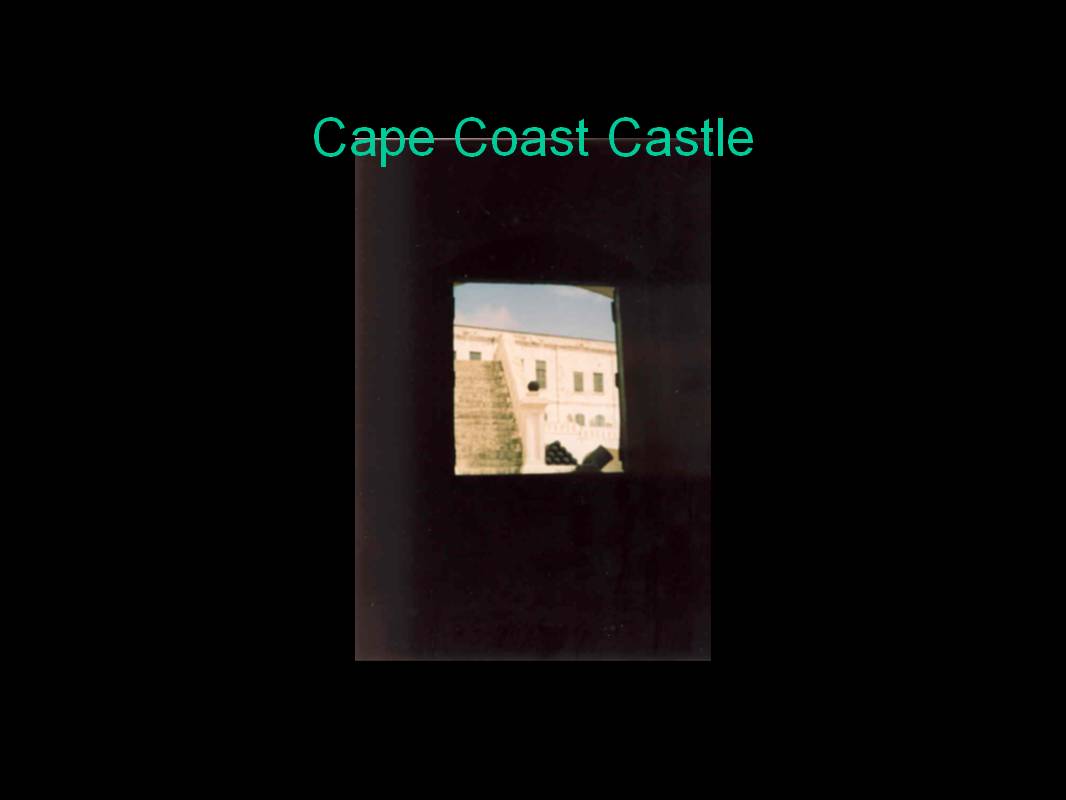
We talked about the colonial history of Ghana and the slave trade.


And the struggle for independence and the reason they are called the "Black Star of Africa"

The first president of Ghana.
The head of the United Nations

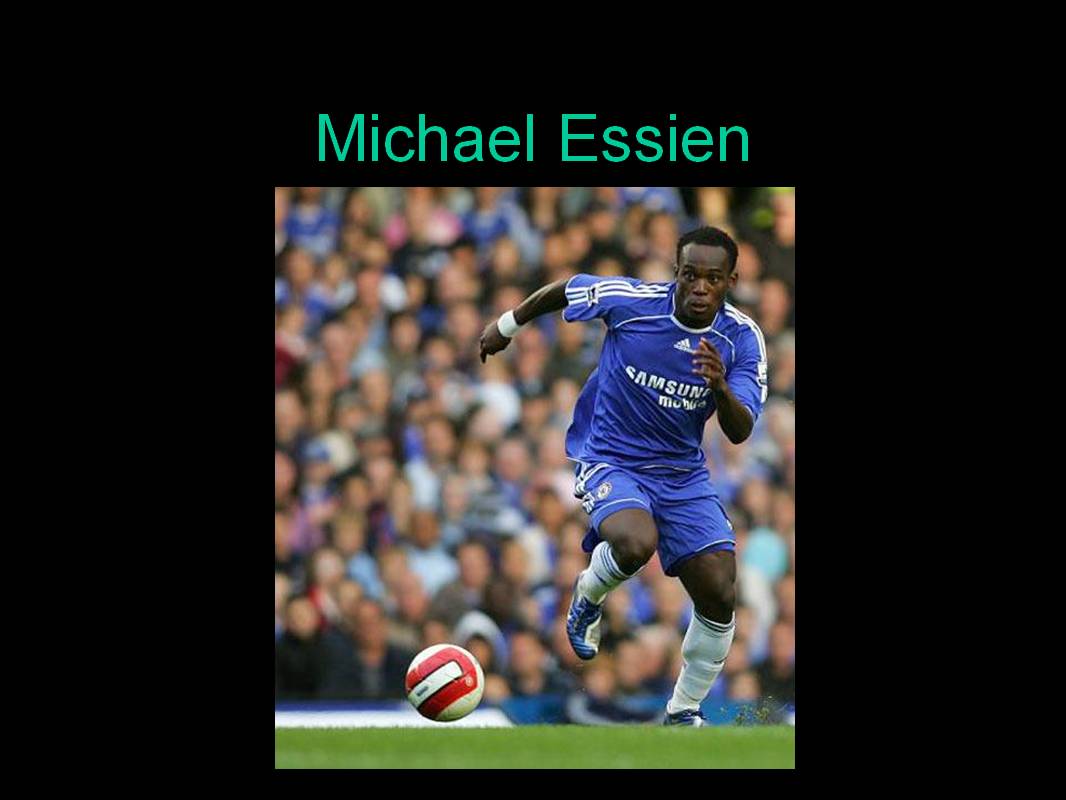
A star soccer player with Chelsea.  One of the kids knew he played for Chelsea, well done there.

Ghanaian by birth, now a US citizen, Freddy was a big deal a few years ago.
I like this slide, the kids liked it too.
Time for another phrase:
This got a laugh.
Talked about how awesome kente is ;-)
And the many adrinka symbols of course.

Asked how many kids played an instrument, and how many were drummers before going into this.
Explained how they used talking drums to communicate between villages.  before cell phones, of course.
Leading into some slides of my village:

The view from my school

Oh yes, the word you'll hear most often!
A good launching point for the ant story.
And my only picture of Mr. Africa, my right-hand man.

A good shot to illustrate how run-down everything is.

talked a bit about corporal punishment here, you know, public canings for misdeeds perpetrated by the students.


Wanted to make sure they could see that the kids were pretty much just regular kids.

And a shot illustrating how simple the furnishings were.


The primary school furnishings were really simple!

School lunch cafeteria
Of course a good discussion on fufu, and getting used to eating fufu.
And a story about the first time I bought a plantain and thought it was a great big banana.
And last but not least a grisly description of kenke, and how I eventually learned to love it.
Illustrating the importance of eating with one's right hand.  My napkin is permanently in my left hand to prevent any social faux pas.
Fried yams and pepper sauce.  How I miss it.
The unique Ghanaian way of eating oranges.  Slice the top off and squeeze.
You know you're in the big city when you see fan ice.  So good.

My favorite egg sandwich stand.  The man was a genius.
Ladies looking good and probably on their way to a funeral, judging by the clothes.  Funerals are a big deal in Ghana.
Everything is named.  This bus or tro-tro is named "Ringo!"  Love it.
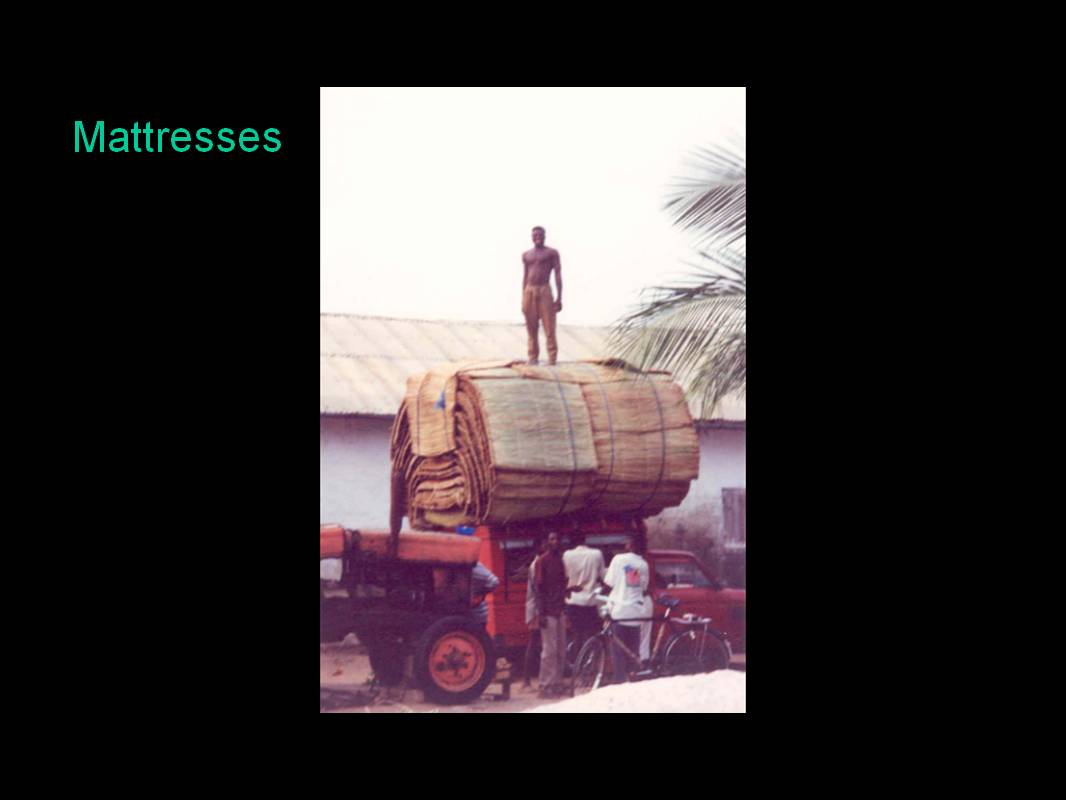
A stack of reed mattresses from Tim's site.
Random Accra street scene.  I'm clearly playing in traffic here, not too smart.
I bought some batik fabric from this lady in Accra.

Wish me luck!  If they're anything like the students I had to teach in Ghana, I'm doomed.  Just kidding, I'm sure it will be fine.  I just hope I'm not too boring.  Oh yes I will pull out the ant story, no question ;-)

Saturday, March 5, 2011

The Great Ant War

The Great Ant War

Dates:

Monday, October 11th, 1993 – Thursday, October 14th, 1993

Battle Field:

The “Jesus Never Fails” house, just outside of Boso, Ghana.

Belligerents:

Humans and companions:
Scott Slusher, Volunteer, Peace Corps, Class I
Kwame, canine, Class I
Mr. Africa, Technical Specialist, Class III

Fauna:
Ants, African Army, Lake Volta Corps

Nature:
Rainy season, tropical version.

Account of the battle as told by the eventual victorious party, Mr. Slusher:

Monday, October 11th, 1993

It all began on October 11th 1993, in the evening.  I was conducting extra math tutoring for my high school students at Boso Secondary Technical School, where I held the position of Math and Science teacher.  A handful of my students were preparing to take their “O” level Math and Science exams in a few short months, and I was trying to prepare them for this difficult exam.  It was night, but the school had electricity and electric lights in some of the rooms so we were able to get a lot of extra studying in that evening.

I tutored my students until about 9:30 pm and then walked home, about a half mile walk from the school.  I lived in a newly-built house in the country outside of Boso.  The house was named “Jesus Never Fails” because that was the slogan painted above the front porch of the house.  It was a nice, comfortable house for Ghanaian standards, and it even sometimes had (cold) running water, but no electricity.  I lived there with my young canine companion, Kwame, thusly named because he was given as a gift to me on a Saturday by my all-around house man, Mr. Africa, thusly named because he could name all the countries in Africa.

The weather had been extremely rainy lately, with powerful storms raking the town several times per day over the past few weeks.  It was nearing the end of the rainy season in Ghana and Nature seemed hell-bent on giving me something to remember it by during the upcoming dry winter.  Thankfully, however, on the evening of October 11th, 1993, the rains were nowhere to be found, and there was even a bright sliver of moon in the West sky.  My house was about a quarter mile from the end of town, located in a dirt plot recently cleared from the forest.  Because of the abundant moonlight, I turned off my flashlight and easily walked home by the light of the moon and stars only.  It was a lovely clear night and I was undisturbed and feeling good (you know, handling it) as I walked home through the hilly Ghanaian countryside, singing Van Morrison to myself, an artist generally reserved for pleasant walks through the countryside.  Life was good.

My house sat back some 50 yards uphill to the West of the road.  I walked up the dirt driveway and idly noted how interesting it was that a little stream had started to form in my front yard because of the heavy rains.  I thought I’d need to build a bridge over the little stream if the rains kept up, as the water was starting to dig up quite a little canyon now.  My house was tucked into the base of a small hill, and as I mounted the steps to my front porch the hill behind my house blocked the moon from view, plunging everything into near darkness.  As accustomed as I was to both the geometry of my house, and living with no light, I thought nothing of navigating through the front porch to my bedroom in the dark.

But something felt wrong.  I’m not sure if I could sense it, or just barely see it, but the front porch appeared to be rippling, almost moving.  I heard Kwame whining quietly in the front porch which was slightly unusual.  I don’t know how, but I could just sense that Kwame and I were not alone in the house.  Instinctively and without hesitation I reached for my flashlight and turned it on, and oh shit its ants

African Army Ants are all over my house!  I’m going to die I’m going to die I’m going to die crap crap crap.  Thick pulsating streams of ants are flooding the floor, walls, and even the ceiling of my front porch.  There are literally thousands of ants in here.  Kwame is standing in the far corner of the porch, whining.  I feel the first bite of an ant.  Holy crap, that hurts.  Then another, and another, and another.  Kwame is getting bit as well.  I know this is bad.  Army ants en masse are perfectly capable of killing a dog, even a horse perhaps.  I am smaller than a horse.  They are looking for food, anything that moves; Kwame and me.  I am living a horror movie.

Take defensive action.  Get Kwame. Check.  Run to the bedroom.  Check.  Are the ants in my bedroom?  Scan the floors, the walls, the ceiling.  Nothing.  Thank God, they haven’t made it this far yet.  A glimmer of hope.  We have a base now from where we can mount a counter attack.  But I fear it won’t last, they’ll eventually get in.

Assess means for thwarting entry into bedroom.  Broom.  Kerosene. Insect spray. Mosquito coil?  Straight-up evacuation.  Assess each idea individually.  Broom.  Limited effectiveness.  Ceiling ants in particular will just fall on top of you like little evil biting flakes of snow.  Kerosene.  Probably effective, but will leave me without light.  Insect Spray.  Probably effective, but looks dodgy and might cause cancer.  Mosquito Coil.  Probably not effective whatsoever.  Evacuation.  But where would we go?  Back to the school, I guess.  I decide to stick it out.  I douse my window sills and door frame with all my kerosene, and spray the same areas with the insect spray.  It’s 10:00 pm and I sit down to jot down a quick note in my journal by the light of my flashlight, and then get onto the bed.  An excerpt from my journal from that evening follows:

“Oct 11 [1993]”
“Ants!  Ants!  Ants to the glory of God!  My house is being besieged by an army of army ants – incredible – there are thousands of them, all over the house no place is safe – they climb into every corner, through every window sill into everything!  … and did I mention that they bite??  Ouch – they bite and bite and bite – our dog was freaking out!  And I am too – I don’t want to go through this again.  The walls of the house are absolutely crawling with army ants.”

So Kwame and I settled in for a long vigilant night in the citadel of my bedroom.  In the dark.  With all of Africa’s ants at my doorstep, so it seemed.  Periodically I would leap up from the bed and manically turn on the flashlight to confirm that the kerosene/insect spray was keeping them at bay.  It was.  I started to fall asleep but the vision of army ants crawling up into my nose and ears quickly woke me up every time.  Eventually I did fall asleep, against every protestation of the primitive part of my brain, and woke up with an involuntary shout of “Ants!” as the dawn was approaching again from the East.  


Tuesday, October 12th, 1993

A quick peek out the bedroom door confirmed that my defense held, and that furthermore the ants had appeared to move on to the next location.  I was safe.  I had nothing with which to cook breakfast, and had turned my house into a highly-flammable cancer-causing death trap, but on the plus-side Kwame and I made it through the night alive.  On my way to school I inspected the new stream that the rainy season had created in my front yard.  I was astonished to see that the army ants from last night had actually built a bridge over the stream using twigs, plants, and dead ants with which they were able to cross over and invade my house.  Or perhaps this was their egress route from the house.  Either way, now viewed with some distance from the terror of the night before, the ant bridge was endlessly fascinating and impressive. 

And a little frigntening.  They are making bridges.  I mean, ants have brains the size of, well, quite frankly I don't even know if they technically have "brains", but collectively they understand how to build a bridge over what to them is a raging torrent of certain death.  Note to self, do not underestimate these guys, somehow they are smarter than you think.  Maybe they have like a distributed brain or something.  One ant all alone, not so smart.  75,000 together, we're approacing Da Vinci territory here.

During the afternoon we got one of the most powerful storms of the season yet.  When I returned back to my house after school the ant bridge was washed clear away and the stream was quite the little torrent.  Nature seemed to be on my side, building for me a little moat around my house.  Mr. Africa stopped by in the evening and brought me more kerosene and dinner, and promised to get a good “ant killing spray” from town if they came back.  Wait, what do you mean, come back?  All in all the day passed in relative quiet terror.  Far better than most other kinds of terror.

Wednesday, October 13th, 1993

From my journal:

“Oct 13 [1993]”

“The ants are returning.  This time, I was here when the initial onslaught took place – they only got to the cement outside of the porch.  Another stream of ants just tried to sneak up behind me but I noticed them in time to sweep them away.”

This time it was still daylight out, and since I was there when the ants showed up I was able to beat them back with some success with a combination of broom and water.  Our house was equipped with a 50 gallon plastic tank of water, fed by the rain, for use when the piped water was not functioning.  I drained almost all the water into smaller buckets and sloshed the water onto the oncoming columns of ants.  I knew that I would not be able to hold them back forever.  If they were determined enough they would eventually outlast me and make another assault on the house.  But quite frankly with nothing better to do, and the feeling that these little biting bastards had made it personal by coming back a second time, I was hell-bent on engaging them in battle as long as possible.


Thursday, October 14th, 1993

Back to the journal:

“Oct 14 [1993]”

“Last night was an ant hell, I suppose.  I didn’t sleep much because I was worried that those ants would at any moment make the final push into my room.  I must have woken up 8 times.  This morning I woke up and the ants had just begin to climb into the interior porch.  I swept them all back and then Mr. Africa came from town with a bunch of DDT, which he liberally applied to all ant-infested areas.”

Did he say DDT?  So this was Mr. Africa’s “ant killing spray”.  Wait, isn’t this stuff illegal?  Doesn’t DDT cause sterility?  Doesn’t it cause freaking cancer?  Shit, I’m out of here! 
           
“I’m concerned about 2 things.  First, I have a feeling that the ants will come back.  Africa assures me that, no, they won’t.  I’ll believe that when I don’t see it.  Second, DDT is a potentially harmful chemical.  I’m none too pleased that I’ve been exposed to it all morning.  Better than ants, I guess?”

Potentially harmful?  Oh I’d say it was definitely harmful.  It sure harmed the ants quite a bit.  They didn’t come back.  The DDT killed many of them, and the rest went away, back into the bush, to find something else to eat. 

So I won the war, but at what cost?  I couldn’t help but think that perhaps the ants would have eventually gone away of their own accord in a few days’ time.  I absolutely felt guilty for allowing Africa to spray the perimeter of my house with DDT.  I didn’t even hesitate to make the call.  Just do it.  I could have told him to stop.  But I just wanted the whole ordeal to be over with.  And besides, I ended up doing something much worse a few weeks later.

It brings to mind a larger question, that is, when living in or even visiting another country, when a situation arises where you could do something that is acceptable in your new country, but not acceptable in your home country, what do you do?  This is a tricky example.  Is it acceptable to employ DDT in the use of pest extermination in the United States?  Clearly no.  In fact I doubt it's even allowed in Ghana in 2011.  But it is acceptable to employ some means to exterminate household pests in general.  Perhaps in this case the proper course of action would be to suggest to Mr. Africa that we try a different, slightly more legal brand of pesticide.  Then I would be making a satisfactory compromise between solving the problem and hanging on to some level of self-worth.

The tragic irony in this particular situation is that while at first glance it seems like I'm "going native" by allowing Mr. Africa to use DDT, in fact I'm doing quite the opposite.  I'm going native only in that way that Ghana tries to emulate the developed world, often times with strange results at best.  I did not know this at the time, but the army ants were not intending on making my house their home.  They were exhibiting classic "raiding" behavior, and once they had ransacked my house for everything they wanted, they would go away.  The truly "native" thing to do would have been to leave my home for a few days, let the ants take what they needed, and then return.  The ants in fact typically do the house a favor by scrubbing it clean of other insects and pests.  Like a good regimen of Flagyl for your home.  Had I known this and was willing to vacate my home for a few days, and willing to just come to grips that I needed to let Fauna win the battle in order to let me win the War, I could have easily stayed away.  So I lost in all possible ways, except my fighting spirit was still intact.  But don't judge me too harshly, many mistakes are made in the heat of battle.  Would you have made a different decision?  Perhaps now you would, I know I would!

Friday, March 4, 2011

The Hughie Daily Memorial Cup

We’re staying with the sports theme today.  I’m posting a reproduction of an article I wrote for “The Talking Drum,” which was our Peace Corps Volunteer quarterly newsletter.  I wrote an article reviewing the “Hughie Daily Memorial Cup” volleyball tournament that we conducted on the last week of our in-country training in Koforidua. 

I probably should provide a little more background for my readers who were not actually with me in Ghana.  First off, when you join the Peace Corps everyone goes through a couple of months of training together.  Typically this training is done “in country”.  In our case we all descended on a boarding school in Koforidua, a large town in the Southern part of Ghana.  It was generally a fun time, and it was a great opportunity to get to know all of the other volunteers before we all got shipped off to hither and yon to go and serve. 

Now Hughie Daily was a fellow Peace Corps trainee, an older gentleman, a fiery rascal, a real slice of life.  He may have been insane.  But we loved Hughie for his ranting ways, and although he was crazy, we were genuinely very sad when he decided that Ghana just wasn’t for him and went back home.  As I recall, Hughie didn’t get sick or anything.  Maybe he got into a fight or something?  Consult the journal!  And once again, my journal disappoints, although it does mention when Hughie went back to the States:

“Aug 13 [1993]”
“Well we lost Hugh Daily today – ET’d – “How the hell should I know” – he really made me laugh, and I do miss the bastard!”  (“How the hell should I know” was Hughie’s catch-phrase)

And that was it!  Oh, and ET’d means “Early Terminated”; that’s the term used to describe someone who leaves before their two-year service is complete.  In retrospect the term sounds so severe!  YOU ARE EARLY TERMINATEED.  GUH-GUH-GUH-GUH-GUH-GUH-GUH.

Well in honor of Hughie, who truly was one of a kind, the volunteer trainees who were still there staged a rousing volleyball tournament in his honor, and here is my account of the day.  I think I was attempting a subtle parody of sports writing with my article.  Oh, and the reason I was not playing is that I was quite ill at the time, how fun for me!

So without further delay, I present:

The Hughie Daily Memorial Cup

S. E. D. Wins Hughie Daily Memorial Cup Volleyball Tournament

The last Sunday of Service Training 1993 was the perfect setting for the First Annual Hughie Daily Memorial Cup Volleyball Tournament.  It was a fierce, muddy, desperate contest that pitted four hungry teams against each other.  All three volunteer sectors were represented, and a Ghanaian National team took the field as a wild card.  The Small Enterprise Development (SED), Education (ED), and Rural Development (RD) teams each eyed the other warily across the pitch.  Each team was desperate to claim the cup, but only one would hoist the cup on this humid field of glory today.

The SED team emerged victorious from the tournament, and brought the memorial cup – a calabash with two enormous goat horns affixed to it – back to their Assistant Peace Corps Director (APCD) Eddie.  In case you missed this historic and heroic competition on September 5th, a brief account follows.

The Hughie Daily Memorial Cup was a thrilling exhibition of volleyball skill.  All four of the teams played hard, but some teams fared better than others.  The RD team, under the stately leadership of Sachu Constantine, failed somehow to win a single game.  “We collapsed!”  Sachu lamented shortly after the tournament, “we #*!@ing collapsed!”

“We went into the tournament on Sunday as the top seed,” he continued, “but injuries and difficulties in getting the correct personnel on the court hindered us.”  For the record, Sachu played in all three games for RD.

Perhaps the defining moment for this RD team was the final play of their second game, against Eddie’s SED team.  RD had already lost their game so they had to win to stay in the hunt for the cup.  It was game point, and Mark Pankoff was set to receive Mike Spingler’s trademark satellite serve.  As Mark tells it, “The ball was way high in the air.  I was going to hit it, but then I thought oh #*!@, it’s going out!  So I tried to jump out of the way at the last second…” but he slipped, and the ball hit him right in the chest and fell to the ground, losing the game for RD and knocking them out of contention for the title.

Amy Kargl, Mark’s teammate, adamantly denied that Mark “threw” the game by his actions.  “He tried.  He really tried.”  She explained, “he just couldn’t get his big body out of the way.”

So RD failed to take the cup this year, losing in spectacular fashion.  But what about next year?  Sachu, for one, has great expectations for the future.  “We’re definitely a team for the 90s,” he predicted, “a dynasty in the making.”  Confident talk there from the captain of the team that failed to win a single game.  Plans include more rigorous training – including a strict athlete’s diet of Club beer and kabobs.  Perhaps next year they will be up to par with the SED, ED, and Ghanaian teams.

Eddie’s SED team and Madeleine’s ED team played each other in the first game of the tournament.  It was a preview of things to come.  The SED team, led by the “Tremendous Tamale Two” – Jim Halsted and Mike ‘Split’ Spingler – played ‘smash-mouth’ volleyball:  an in-your-face, emotional, powerful  game.  This contrasted sharply with the ED team’s more cerebral style.  Led by the fearsome “Koforidua Skyline” front court of Stacie Wikman, Tim Dorpinghaus, and Chip Laitinen, ED was a finely-tuned volleyball winning maching.  Efficient and skilled, they were a quiet, deadly force.

Ed was too much for SED in the first match, defeating them in a close game.  “We planned to lose,” commented Mike Spingler, “to make [the ED team] overconfident.”  Angela Thoemke, a player from the ED team, say things differently:  “That first game was won by our superior skill.  Did you see [SED] out there?  They weren’t playing as a team.”

SED, after losing their first game, faced an uphill climb to the finals through the relegation bracket.  But they rose to the occasion.  IN their second match the disposed of the RD team in the gritty and thrilling match won on Split’s remarkable satellite serve into Mark’s chest.  Next they defeated the youthful talented Ghanaian team, whose penchant for chaos seemed to trip them up just when they seemed to be getting the upper hand.

The ED team finished off the Ghanaian and ED teams, demolishing them with wicked clothesline serves and textbook spikes.  So it was inevitable – SED vs. ED in the best-of-three finals.

Obviously ED was the favorite.  “They’re unstoppable,” confided Buffy Cashel, “they haven’t lost a game yet!”  ED did look strong – but there were some surprises in store on this day of the cup.

Just before the finals it began to rain.  During the tropical deluge Scott Slusher, the event’s sponsor, took some time and gave a moving and inspirational reading from Hughie’s letter.  When the rain subsided and play was resumed, it was on a court now slippery with soft mud.

The new conditions worked against the ED team.  “That was the team’s downfall,” commented Jon Hester, a thoughtful observer, “They looked kind of lost out there.” 

But perhaps ED was also startled by the appearance of two of their own ED volunteers on the SED team for the finals.  Dave Lathrop and Lisa Theece, two formidable and highly competent volleyball players – and Education volunteers, not Small Enterprise Development volunteers – were recruited by Jim during the rain delay to join the SED team.

Whether it was the weather, or the new and improved SED lineup, ED struggled against SED’s attack, losing two matches in a row and conceding the cup to SED.  Eddie’s SEd team was awarded the cup and declared the tournament champions, but the victory was not without some measure of controversy. 

Angela agreed that the rain hampered her team’s effort in the finals, but she attributed the loss more to juju than to superior play by SED: “somehow they used juju to make it rain – knowing that it would hurt our style of play more.”

Mike’s analysis of the finals was predictably different:  “it was team players against a bunch of individuals.  We played as a unit – out motivating factory was to honor Hughie Daily.”  The juju claim, he said, was “too stupid to even comment upon.”

Then there was the question surrounding the legality of having ED ‘ringers’ on the SED team for the finals.  According to Jon Hester, who questioned the legality of the ringers, “Dave and Lisa made a definite positive impact [on the SED team’s performance].”  Mark Pankoff was less diplomatic about the whole affair:  “I think the presence of the ringers makes the victory null and void.”

Did this take anything away from SED’s victory?  “No, it didn’t – it enhanced our win.  And,” Mike observed, “if [Dave and Lisa] were so good, why did [ED] let them off their team?”

Additionally there was the controversy surrounding Jim Halstead’s yellow card.  Sachu, who officiated the finals, administered a yellow card to Jim for, as he saw it, “excessive whining.”  Jim for his part refused to accept the official punishment of a slide in the mud.

“That call was ridiculous,” according to Mike.  “Sach has the biggest mouth – I’m glad we shut him up.”  Angela, of course, disagreed:  “The whole brutality of the situation was that the ref’s authority was challenged.  We felt cheated.”

However, after their second and final defeat, members of the ED team vindicated themselves to an extent by tackling Jim and dragging him through the mud.  Was justice served?  “We don’t encourage that kind of vigilantism – but”, Sachu explained, “Jim got what he deserved.”

Observers generally agreed that SED’s violations were not sufficient to strip them from the title, so the memorial cup was presented to Eddie’s SED team in a spirited ceremony.  SED looks forward to defending the title next year, while Eddie proudly displays the cup in his office, and Steve and Madeleine seethe with envy.

And what, by the way, might Hughie Daly, the very inspiration for this event, have to say about it?  In the words of the great man himself, “HOW THE HELL WOULD I KNOW!”


Well wherever you are Hughie, I hope you’re doing well.  And I wonder whatever happened to that calabash with the goat horns attached to it?

Thursday, March 3, 2011

The Sporting Life


You know what would be cool here? I thought to myself as I stood on the wide, cracked concrete veranda of my school administration block, looking at a forlorn corner of the school grounds.  A basketball court!  I mean, what kid doesn’t love basketball, right?  Ghanaian kids, apparently, do not love basketball.  Or any other sport, save one.  There is room for one sport and one sport only in the hearts and minds of the youth of Ghana; football.  And not the gladiatorial blood-sport I was happily brought up with and still love, but, you know, English football. 

But I was not to be deterred.  You see, somehow I had got this idea in my head that if I could get a basketball court built at my school, then coach this rag-tag bunch of high school students into a explosive, dominant basketball barnstorming force, then I could secure for them scholarships at American universities and quite possibly untold riches and fame.  I only had two main obstacles to overcome.  One, we had no money with which to build a basketball court.  Two, the students did not seem to be interested in learning how to play basketball.  Not in the least.  Another issue was that I could not coach, much less play basketball myself.  But this is about the kids!  I could figure all that out later.

Obstacle One (money) was actually sort of a solution to another problem, in a strange way.  And that problem was The Project.  A little known fact – at least to me at the time – about the Peace Corps is that all Peace Corps Volunteers are expected to raise money for, and execute a development project during their service.  For Business Development, Health, and Rural Development volunteers, this project is probably the main focus of their service.  And Education volunteers such as myself are also expected to perform some sort of project, perhaps somewhat smaller in scale, in addition to fulfilling their teaching duties.  All volunteers are expected to go to their site (town, village, etc.), assess what needs to be done, prepare a project plan, raise capital from both local sources and from back home, and execute the project successfully.  Sometimes the hardest part is determining what needs to be done.  In many cases, pretty much everything needs to be done, so it’s a question of prioritizing what can be done in the allotted time and with the amount of money that can be reasonably raised, what the community will get behind and support, and what the volunteer has the expertise to implement.


For example it may be that the volunteer’s village could really benefit from a water treatment plant, sever system, and storm drain system.  Well, yeah, all that stuff would be great!  But it is doubtful that all of that could be designed, funded, and built by a Peace Corps volunteer.  In fact it may be that such a grandiose project is not appropriate for a poor village, even though it would be quite beneficial, because they may not be able to maintain an expensive project after the Peace Corps volunteer is gone and the initial start-up money is gone.  So a reasonable compromise might be a set of latrines or a new well for the village.  I’m going to give a shout out here to Water for People, a top notch organization that is dedicated to providing clean and assessable water to people in developing countries.  My friend Kate works for them and they do wonderful work in South America and all over the world.

Now even in my village, some sort of water or sanitation project may have been a really good idea.  The volunteer who served at my school before me, Mary, raised money to build a science building on campus, and had it stocked with text books and chemistry sets and what not.  This seemed very appropriate and quite frankly a hard act to follow.  Mary built a freaking building, for goodness’ sake.  My wonderful idea?  Oh yeah, basketball court.  I even went around town and drummed up support and got bids on how much it would cost to make a basketball court.  Level the ground, pour the concrete, paint the lines, order and install the poles, backboards, and hoops, and obtain actual basketballs and uniforms.  The total cost came out to about 250,000 cidis.  The exchange rate at the time was about 500 cidis to one dollar.  So we’re talking about $500, total cost.  I could probably get the basketballs and hoops donated from the States.  Most of the cost would be in the concrete and labor.  This, I thought, was totally do-able.

And totally useless.  Yes I was living proof that aid projects can and do go totally wrong, all the time, and for a myriad of reasons.  This project was destined for failure for two reasons:  One, I felt obligated to “do a project,” so I ran with the first thing I thought of, instead of really sitting down with the school staff and thinking of some things that the school might actually need, and Two, well, reason One is probably sufficient.

And really, all I had to do was open my eyes and look around to see several projects that would have been more appropriate.  Here are just a few:  The school classrooms had windows but no screens or blinds or actual glass.  When violent rainstorms blew through the school we literally could not conduct class because the wind and rain would blow everyone’s books and papers all over the place.  And this being tropical Africa, we had more than our fair share of violent rainstorms.  We also couldn’t have class during the storms because of the ear-splitting cacophony of the rain assaulting the metal roofs of the school rooms, but blinds or windows or something would at least protect the school supplies, and potentially even allow the kids to continue to sit and do school work while waiting for the storm to pass. 

Also the kids had to trek about 100 yards up the hill from the school to fetch water from a faucet for the school day.  My town did have running water – most of the time – but there was only one faucet for the school and it was up the hill from the school grounds.  Perhaps a system of pipes to bring the water closer to the school would save the students some time and labor. 

Finally, and this may not seem like a huge deal, but the schoolroom “chalkboards” were actually just rough concrete, painted black.  The rough surface consumed chalk at a prodigious rate, forcing us to spend far more on chalk than we really needed to.  A set of real chalkboards, or even just smoother concrete painted black, would reduce that expense by a great deal and quite possibly improve the legibility of my handwriting, although that last part is debatable and quite frankly wouldn’t make it into any chalkboard replacement proposals.

Sure, all of this seems obvious to me now, but at the time I was just, you know, used to it.  It was difficult to remove myself from the situation and realize what could be changed to make things better.  Kids carrying 30 pound buckets of water on their heads?  Hey, that’s quaint!  Looks like real Africa, take a picture!  Can’t teach because of the tropical deluge?  Wow, revel in the majestic power of Nature!  It wasn’t that I was being callous; the point I’m trying to make is that I was adapting quite well to my surroundings, which was good in some ways because it kept me somewhat happy and sane on a day-to-day basis.  I was handling it.  Except that my surroundings could, you know, be improved somewhat without too much effort from me.  Handling it was good, nothing wrong there, many Peace Corps volunteers never make it to handling it.  So jolly good there.  But improving it is even better.  And apparently improving it in my mind meant putting up a basketball court.  Sounds silly at first blush, but in my defense I thought that it would be nice to offer the students something fun to do at school.  They were all interested in life in the United States and I’m sure most of them would jump at the chance to live in America.  If I told my students that by playing basketball they could come to America and become wealthy, they by gosh they would have lined up to do it.  So the court represented something totally new and exciting.  And, truth be told, it was a little slice of home for yours truly.  I think it was easier for me to see what was totally missing than what could be improved.

Problem Two.  Desire.  I can still picture the scene now, going on 20 years after the fact.  I was going to convince the students that a basketball court would be fun.  I had this whole argument lined up and everything.  I think the conversation went something like this:

Me:  “Hey students; I’m thinking about putting up a basketball court at the school, what do you think?” 

Students:  “But master (teachers are called masters there), none of us have ever played basketball.”   
I was prepared for that answer.

Me:  “Well have you heard of basketball?   Michael Jordon?  Dikembe Mutombo?  He’s from Africa, even!”

Students:  “Yes we know about Michael Jordon.”   
…and…

Me:  “And Dikembe?”

Students:  (insert pause here)  
…and??

Not good.  My whole argument had just gone off the rails. 

Me:  “Dikembe Mutombo?!  He is a huge basketball star!  And from Africa, right?  You know, with the finger-wag and all the blocked shots and all that?  No?  What about when the Denver Nuggets won that playoff game, and Dikembe fell on the floor and cried and clutched the ball and cried some more?  Nothing?  This was, only like the greatest moment in sports history or something.  I mean, Dikembe wept tears of joy, and all of Africa wept with him!  Well Zaire wept tears of joy, I just know it.  Ok so Dikembe is not from Ghana.  Zaire, Ghana, Ghana, Zaire, weren’t you happy that an African player was doing so well in the United States?  And if he can do it, why not you?”

(pause)

Students:  “But master, if you please; we don’t know who Dikembe Mutombo is.”

Me:  “Fine.  You don’t know Dikembe.  What if I told you if we built a basketball court, then Dikembe Mutumbo would come and visit you?”

(silence)

Me: “Michael Jordon?  What if I told you Michael Jordon would come visit?  Would that be cool?”  
Oh my god I’m saying “cool” to a room full of high school students.  I just made ‘cool’ un-cool.

(Uncomfortable silence.  They don’t believe I can get Michael Jordon, and now they think I am an un-cool liar.  They are, of course, correct.  On all counts.)

“Fine: Well, I’m going to build the basketball court, and teach you all how to play basketball.  Would that be fun?”

Students:  “Yes, but would we have to miss football?”

And now we get to the heart of the matter.  Football.  They love football.  They don’t even like anything else.  I immediately grasped the difficulty of my situation as the basketball coach.  All the most athletic students would continue to play football.  I would have my pick of some of the kids that a) were not good enough for the school football team, and b) had no interest in watching the school football team.  This left we with probably 2 or 3 kids, maximum, who would be willing to spend their free time learning and playing basketball. 
But it could turn into one of those inspirational 80s movie montages!  First, just me and one or two kids.  They’re learning how to dribble.  They can’t make the lay-up.  Then they get a little better.  A couple more kids join in.  They're making a free-throw now.  Several more leave the football field and come over.  Next thing you know, Jimi Jamison is hitting the high notes and that same kid who couldn’t make the lay-up is executing a 360 tomahawk jam in slow motion over the head of the blond Russian kid, while Dikembe and I exchange a high-five on the sideline – well, a low-five for Dikembe, probably – and the politburo walks out in disgust.

How did the Soviets get in there?  Anyway, there would be no Dikembe, no basketball court.  I ended up not building the court, you can probably understand why.  I would like to think that if I stayed longer I would have sorted this out at some point and got to work on something more meaningful.  As you’ll see, thankfully for all involved -- except for the guy who makes the concrete -- I was never to realize my feverish dream of installing a basketball court because I did not stay to the end of my two-year term at the school.  But that’s for another day. 

And of course if you know anything about Dikembe Mutumbo, you know that he is an absolute saint when it comes to charity work in Africa.  He speaks nine languages (while I’m struggling with one and a half in Ghana), has started a charity foundation that has built hospitals and funded other development projects in the Congo (formerly Zaire), and yea, was a heck of a basketball player for many years, some with my local Denver Nuggets.  And according to the Onion, he is now a Senator.


Wednesday, March 2, 2011

Jimmy Hlam


Let’s begin again, shall we?  I think we got off on the wrong, ever so slightly smelly foot yesterday.  I will play things straight-up today and talk about the formation of the Peace Corps, 50 years ago today (I’m writing this on March 1st).  Quite frankly, although I was in the Peace Corps, I really don’t know much about the history of this now-August institution.  This probably makes me a bad RPCV.  I will quickly remedy the situation and drag you all along with me.

Ok, first of all, why do we fix March 1st as the date of the formation of the Peace Corps?  The answer to that is pretty simple.  March 1st, 1961, was the date John F Kennedy signed an “Executive Order” mandating that the State Department create a new agency called the Peace Corps, with the basic aim of providing assistance abroad.  I found a copy of the actual document on line, it’s pretty neat!  It looks yellowed with age, vintage.  Typed by a secretary in a white house office pool, no doubt.  I wonder if presidents do their own typing these days?  The second page has a signature on it that is presumably that of JFK, but at first blush doesn’t look like it spells his name.  To me it looks more like “Hlam A Jimmy”.  I should talk;  My signature looks like "Sl^_li R Sl%^\ds_e". Could there be controversy from the get-go?  Back to Google and we discover that the signature does indeed look like JFK’s regular signature.  Ok, I can dispense with my “Jimmy Hlam is a Vietnamese double-agent and the Peace Corps was a front for the Viet Cong” conspiracy theories for now.

Peace Cops.  Peace.  Corps.  Why call it Peace Corps?  The more I think about it the more odd the name sounds.  It’s a bit of oxymoron, you know?  Like “Jumbo Shrimp”.  Or “Table Mesa”.  No wait, that’s something else.  To me, the term “Peace Corps” even has a slightly Orwellian doublespeak feel to it.  Like UN Peacekeeping soldiers.  Baby blue helmets and black steel rifles.  As a volunteer I can without hesitation tell you that we were given no rifles, and our helmets were of the bicycle riding sort.  Mine may have been baby blue though.  And thank goodness I had one, as you will soon learn.

Let’s dissect this further and past the point of all reason.  Peace Corps.  Why “Corps”?  The term corps does have a militaristic etymology associated with it.  Corps is typically a term used to describe a large group of soldiers.  Why not, say Peace “Group”, or Peace “Volunteers”?  Heck, now that I’m into it, why “Peace” at all for that matter?  I don’t think the intent was to go out there and “Wage Peace” all over the earth, was it?  I get the image in my head of a bunch of beatnik hippies disembarking from a Marine landing craft, a la, Normandy at D-Day, singing “…everybody get together, try to love one another right now”, while putting flowers in the barrels of Nazi rifles.  But maybe I’m taking a too literal view of things here.  Let’s break it down and see if we can figure this out, shall we?

Reading JFK’s brief executive order from 1961, I discover that The Peace Corps was founded under the authority of the “Mutual Security” act of 1954.  To me that also sounds like a euphemism for something militaristic.  So I looked it up, and it turns out the Mutual Security act of 1954 authorized, among other things like a “discretionary contingency fund” (where the beer for the embassy party comes from no doubt), development assistance, and food aid to foreign countries.  That actually sounds pretty reasonable.  The reason for the odd name is probably due to the fact that the Mutual Security Acts (there were several) were more or less continuations of the famous Marshall Plan, which had its roots in World War II.  So the Peace Corps can be seen as an extension of post-war rebuilding efforts.  In my opinion, the Marshall Plan did provide Mutual Security by helping to rebuild Europe after World War II and keep us from having to get involved in another costly war. 

For those of you unfamiliar with such things, the Marshall Plan was a massive and expensive project that the United States funded to assist European countries affected by World War II in their rebuilding efforts.  US allies (France, UK, etc.), independents (I’m looking at you, Switzerland, how did you manage to get Marshall Plan aid when you did not participate in the war?) and enemies (Germany, Italy) received aid for rebuilding.  Why give aid to Germany?  Didn’t they cause most of this mess?  Very true, but the prevailing thought was that by penalizing Germany with enormous and punitive war reparations after World War I (named in retrospect, of course), the allies unwittingly planted the seeds that blossomed into the Nazi state and ultimately World War II.  So this time the victorious allies figured a different approach might be better.  Hence the Marshall Plan and the rebuilding of Germany instead of another round of economy crippling, hyper-inflation inducing war reparations and, potentially, WWIII.  We had the Soviets for that, anyway.

It is likely that our entire foreign aid policy can trace its roots to the Marshall Plan, which in my opinion can be distilled to this simple concept:  Help those who are less fortunate than yourselves, because it’s the right thing to do of course, but also in order to prevent them from fighting amongst and between themselves, and with you, and dragging you back into their mess. Sounds reasonable now, perhaps, but was likely not an obvious course of action then.  Since the policy more-or-less worked in Europe then it would stand to reason that it could work in other places as well.  So the aim of Mutual Security is to prevent war, because war is costly.  And the opposite of War is, wait for it, Peace. 

Viewed in that context, I think the term “Peace Corps” is appropriate.  Certainly I did not feel like I was “Waging Peace” in Ghana although I did spend a lot of time listening to Simon & Garfunkel while I was there, and my hair was longer as well.  But in a way I suppose I was waging a little peace.  If I did nothing more than learn about another culture, and allow others to do the same about mine, then I think I can say that I contributed in some infinitesimal way to peaceful relations between the USA and Ghana.  And as far as the aid; well, this was no Marshall Plan, but I was contributing to the local economy, spending USA taxpayers’ money in a small village in Ghana.  Mostly I supported the local food market and, uh, beverage distributors, but it was something.  I plan on discussing foreign aid at length in another post, but although I never built a road or a school, I am happy to have directly supported in some small way the local economy of a poor country.  Hope you don’t mind me spending your hard-earned tax money that way.

The concept of the Peace Corps actually predated JFK by some several years.  It was known as the “Point Four Youth Corps” for a while.  It would appear as though JFK came up with the term “Peace Corps”, but the truth is it was an aide to Hubert Humphrey, Peter Grothe, who coined the term while writing for Sen. Humphrey a draft of a foreign relations bill that Humphrey was working on in early 1960, about one year before the Peace Corps executive order was signed.  There is an interesting article on it here.  From what I can gather, the term mostly stuck because, for all its faults, it was just darn catchy.  Peace Corps.  Jumbo Shrimp.


Tuesday, March 1, 2011

Samosas

Where it began?  For me?  At a lonely Peace Corps recruiter’s table in the BYU student center ballroom.  For the Peace Corps, we may as well give credit to John F. Kennedy for getting the ball rolling, and even before him Dr. Maurice Albertson’s shadow looms large over the history of the Peace Corps, and looms larger over the Colorado State University campus, where I attended a little Peace Corps reception on Monday evening.  We will get to Dr. Albertson, JFK, and the beginnings of Peace Corps in due time.  50 years ago they helped start a program typical in the wide-eyed audacity of its time, and yet unique and trailblazing and enduring.  Over 200,000 people have volunteered with the Peace Corps in the intervening half-century, and I of course am one of them.  And this month the Peace Corps looks back at what it all meant, and I do the same. 

Monday night CSU piled on to the 50th anniversary celebrations with a nice reception after work, which meant among other things free samosas and chai tea up at the second floor of the CSU Morgan library for yours truly.  The Morgan library is right on my way home from work so it was an easy commute to the reception.  I didn’t really know anyone there and I didn’t register for the reception ahead of time, so I didn’t get a cool name tag and I wandered around anonymously.  Without a nametag I was viewed with suspicion!  Ooh, I like playing the bad guy.  Or the CIA mole. 

Rumor has it that every annual Peace Corps group in every country has within it one or more CIA agents who are responsible for looking and acting like Peace Corps volunteers, but are actually there to keep tabs on the rest of the volunteers.  You know; someone who could report back to Langely in coded messages via the diplomatic pouch on the un-American activities of their fellow citizens out in the bush.  Someone friendly, someone nice, someone you could talk to, you know, maybe me! 

We liked to play the “who is the CIA mole?” game over beers whenever us volunteers got together in the capital.  My name never came up as a potential mole.  At least not while I was playing.  I suppose that makes sense; if someone thought you were the CIA mole, they wouldn’t implicate you in your presence, right?  Unless they wanted to put you off your guard, in which case they might implicate you to your face just to make you think they didn’t suspect you, even though they did.  So I can clearly not choose the CIA Mole in front of me.  And even though I wasn’t the mole (I promise!!), I was just a tiny bit put out that no one seemed to think I could make a good mole.  But now that I think about it, drawing attention to myself at the CSU reception by not wearing a name tag is not very good CIA-mole-like behavior.  A CIA Mole would have a name tag with a fake name like Curtis I. Anderson or Ima Mole or something.  Not having a name tag at all is more like wedding-crasher behavior.  

So I smiled a lot and tried not to make too much eye-contact, and helped myself to a second plate of samosas, while awesomely not wearing a name tag. Ha!  But in mid-samosa-wolf I was approached by one of the organizers, who asked where I served (Ghana) and how I heard about the reception (Email? I think?).  Even though I gave real answers, I felt like I was still crashing a wedding for some reason.  Probably because I wanted to tuck into a third plate of samosas, and respectable, invited guests would clearly have stopped at one plate. 

But invited or not, I’m not a respectable, well-behaved guest.  I am a Returned Peace Corps Volunteer (RPCV).  There’s a difference.  You’ll wonder why I’m so focused on the free food, perhaps.  If you are a RPCV, you’ll know exactly what I’m talking about.  I’m surprised there was any food left by the time I got to the reception, and I was only 20 minutes late (or as any Peace Corps volunteer will tell you, right on time, baby).  This is – I thought – a room full of Returned Peace Corps Volunteers, is it not?  Let’s act the part, people!  You have never witnessed such raping and pillaging of a free buffet table as in the presence of a few dozen Peace Corps Volunteers.  In fact this was one of the very first lessons I was taught in Ghana when I arrived in July of 1993.  Never refuse free food.  Especially free Western food. 

My group of Peace Corps volunteers arrived in Accra, Ghana, on July 11th, 1993.  I think.  I looked up the date in my journal but I’m not totally sure if the date is correct.  It may have been July 10th.  Whatever.  My Peace Corps journal sucks, it’s a colossal disappointment in many respects.  But more on that later in the month.  One of the few details my journal does provide is the date of our initial reception at the U.S. ambassador’s residence, on July 12th.  I spent most of my journal entry describing the Ghanaian drumming and dancing to which we were treated, which was pretty spectacular, but what I failed to mention in the journal but stands out quite clearly now is that this was the first time us new volunteers met the older volunteers. 

Peace Corps Volunteers serve for two years.  But a new group of volunteers gets sent to each country on a yearly basis.  At least that’s how it worked in Ghana.  So that when we arrived, all jet-lagged, hung-over, and completely freaked out, we were quickly met with the spectacle of all the volunteers that had already been there a year, and even those who were finishing up their second year and getting close to completing their service, but had not yet left.  While serving in the Peace Corps, volunteers are stationed all over the country in far-flung villages, and generally have minimal contact with each other.  But there are a few occasions when they all get back together for training and conferences, and yes, to meet the new volunteers.  From our perspective, it was really neat to see the volunteers who had survived a year.  It was supposed to give us confidence.  You can do this!  These people did!  From their perspective it was a chance to scare the holy living hell out of us.  Like I needed any additional reasons to be freaked out, since the dominant thought in my head for my first week in Ghana can be neatly summed up as: I'm in Africa and I'm going to die!

But it was fun to meet everyone, my low-level panic notwithstanding.  And the U.S. Ambassador to Ghana was kind enough to host all of us for a party at his residence.  And I can tell you that the older volunteers waged a spectacularly barbaric campaign of utter annihilation on the free food and booze.  It was breathtaking.  It was mesmerizing.  It was downright scary.  Crap, these guys are seriously hungry.  Crap, that’s going to be me in a year (try a week…).  Crap, there’s almost no beer left.  I must point out here that not only did they have free beer, it was American beer.  Budweiser and what not.  Having just arrived in Ghana the awesomeness of that fact was lost on me.  In retrospect I clearly understand why there was such a mad-rush to the free food and beer.  Peace Corps practical lesson #1.  Do not turn down free food.  Why it’s downright disrespectful to not inhale any and every edible thing within reach, right? 

Incidentally this may have been the moment I stopped being a vegetarian, at least in my heart.  I made it all the way through college without eating meat.  I probably made it two or three entire days in Ghana without eating meat.  At least I think it was meat.  Yes, it was meat, I’m just not sure what species of meat.  Oh there’s much more to talk about in the ways of Ghanaian cuisine, just you wait.  And it’s not all bad, I promise.  But we are discussing Peace Corps Volunteer Free Buffet Ettiquete, which is not unlike that of a pirate.  Take all you can.  Give nothing back.  For tomorrow there may not be free buffet, or any sort of buffet, or food, even, so get it now! 

Which is why I was feeling a little out of place at the CSU reception.  I seemed to be the only one still playing the part, salivating over the abundance of samosas piled high in a greasy, glistening pile of fried goodness, calculating in my head how many I could stuff in the pockets of my jacket for later.  I never did get that third plate as I was directed away from the buffet by my inquisitor towards an older gentleman who served in Ghana back in 1966.  The Peace Corps only started in 1961 so this gentleman, Martin, was truly an old school volunteer!  Pretty cool.  We bandied about our experiences: he was a teacher in Tema, a big city on the coast.  I was a teacher in Boso, a small village in the hills.  We got to play the “whose conditions were worse” game a bit.  He conceded early; he had electricity.  In 1966, he had electricity.  In 1993 I had none.  Victory (of a sort) was mine!  Which is rare, because my conditions really were not that bad compared to most of the volunteers in Ghana. 

So I won the battle, but lost the campaign, because just then Martin leaned in real close and started speaking Twi to me.  Oh my God he’s speaking Twi.  And he’s close-talking.  What the hell is he saying? And why is he talking so close? Just smile and pretend you understand him...  If I only had a plate of samosas with me I could use it as a close-talk buffer.  Mmmmm, samosas...  Seriously what is he saying?  I don’t understand him.  Oh please stop with the close-talk-Twi, please?  You win, I am such a fraud!  I was thoroughly routed.  Twi is the dominant language in the Southern part of Ghana, other than English, of course, which is the lingua franca of Ghana, and which I thankfully do speak.  When I was in Ghana I seemed to pick up Twi pretty well.  I just never used it, and I taught school in English, and I simply forgot it all when I came back.  Maybe when Martin was there in 1966 fewer people spoke English so he had to speak Twi more.  But Martin has been back from the Peace Corps for over 40 years, longer than I’ve been alive, and he can still rattle off Twi like he is at the market buying fried plantain and chili sauce.  Quite frankly I never really made a serious effort to learn Twi.  My village spoke Guan, which was a dialect of Twi, but I never really bothered to learn that, either.  Time to beat a hasty retreat to the samosas! 

But then it was time for the official proclamations, so I sat down on the floor and listened to some nice speeches. First up was Dr. Pat Burns, who was one of my old advisers at CSU.  Dr. Burns stressed the importance of Colorado State University to the Peace Corps.  First and foremost, of course, he mentioned the late great Dr. Maurice Albertson and the work he did in writing the original Peace Corps feasibility study in 1960.  Dr. Burns also mentioned that Colorado State continues to send many graduates to the Peace Corps, and ranked 10th overall last year among universities.  The University of Colorado, it should be noted, ranked 1st in the country last year, making Colorado on the whole on par with California and Michigan as stalwarts of Peace Corps Volunteer recruits. Dr. Tony Frank, president of CSU, was next, and he sported a splendid Todd Helton-inspired beard while saying nice things about CSU and the Peace Corps.  Next up was the mayor of Fort Collins, Mayor Hutchinson, who looks like he’s lost some weight since we last met (see here), so maybe he has been riding his bike to work after all.  Then my State Representative John Kefalas had some interesting things to say about his experiences in the Peace Corps in El Salvador in the late 70s, you know, right when things really got bad in that country.  One too many CIA moles in that country, one would suspect.  Finally a recently-returned RPCV (Returned Peace Corps Volunteer) Maggie gave a spirited and ever-so-slightly manic talk about serving in Madagascar.  Manic in a good way, I assure you.  Maggie is helping coordinate my Peace Corps booth visit on campus later this week so I will also mention that she is a very nice, energetic, intelligent young woman.  And I sat comfortably cross-legged on the floor for all the speeches, and thought that the yoga is treating me well, as I am pretty much the only person sitting cross-legged on the floor here. 

After that all the RPCVs in attendance were instructed to stand on a staircase for a big group photo.  We were all pretty well mashed together on the stairs, which is another rather Peace Corps-ian experience (now we’re all close-talking!), although usually in a death-trap nee bus with benches for seats and wooden splints for struts, not on a staircase.  And I was able to contribute to the authenticity of the experience via the distinctive and pungent odor of my stinky feet, which I am certain was delightful and nostalgic for all involved.  Seriously, my feet smelled nasty.  It certainly heightened the sense of claustrophobia and dull panic.  Note to self, don’t wear your trail-running shoes to the Peace Corps party tomorrow night. 

The reception was capped off for me by a chat with my old history professor, Dr. Griswold.  He is now since retired, but is a RPCV himself and it was nice to see him again.  He’s looking good and energetic, but I’m not sure if he remembered me, and when I asked how he was doing he replied “still alive,” to which I had no witty retort.  Me too, I thought.  There were times in the Peace Corps when I wasn’t so sure how much longer I would be alive, that’s for sure, but again, more on that later. 

On the way out of the library I spent a few minutes in the lobby looking for the small sandstone plaque purchased by my family for the library expansion in honor of my late step-father Tom, who attended CSU for a couple of years in the late 60s where he was pursuing a Ph.D. in Atmospheric Science.  Smart guy.  I couldn’t remember where his plaque was though. I think it may have been behind the little coffee bar in the library lobby where I couldn’t see it, but I was a little embarrassed that I couldn’t remember its exact location all the same, mixed in with all the other plaques in the lobby.  I gave up the hunt and as I left the library I wondered what he might have thought about me going to the Peace Corps.  Probably would have thought it pretty cool.  I know I do.

More tomorrow!


Monday, February 28, 2011

Peace Corps Month

Watch this space!


As many of you know, back some 17 years ago I served as a Peace Corps Volunteer as a fresh-faced long-haired youth right out of college.  It was one of the most intense, rewarding, difficult, and interesting experiences of my life.  And some of you may also know that this March the Peace Corps is celebrating its 50th anniversary, having been established by the Kennedy administration way back in 1961.  To honor this achievement and look back on my own experiences, I aim to make this March my very own “Peace Corps Month”.  I will be giving a few presentations around town, attending social gatherings and commendations, and most dauntingly attempting to post a Peace Corps-related blog entry every day this March, starting tomorrow.  I will be writing about my experiences serving as a High School math and science teacher in rural Ghana in 1993-1994, and also about the broader history of the Peace Corps, and finally about my activities this month as part of the 50th anniversary celebrations.  So I invite you to come along with me on this ride, which is sure to be as bumpy and noisy as a bus ride through the wilds of West Africa.

Now even though it is not yet March (and I have one more day to gather my wits and collect my thoughts for 31 consecutive days of blogging, thank goodness), CSU is jumping the gun and will host a reception for an exhibit at the Morgan Library today from 4:00 until 6:00 this evening.  From the CSU web site:
50 Years of Volunteering: The Peace Corps at CSU
Returned Peace Corps volunteers, nominees, and all supporters of the Peace Corps are invited to celebrate CSU's historic involvement with an exhibition and reception in the Morgan Library. Exhibition runs from Feb. 11 - March 31. Opening Reception will be held: Feb. 28 • 4:00 - 6:00 p.m. • Morgan Library, Second Floor”
Word has it the mayor will be giving some sort of proclamation at 4:30.  If it is anything like a Ghanaian official reception, it will last all night and it will be festive!


Also looking ahead to this Wednesday, I will be posted at the “Health Market Table” at the CSU exercise center, chatting to students about, uh, the “health benefits” of serving as a Peace Corps Volunteer.  I don’t think we’ll get into health benefits too much as I believe the point is to promote the Peace Corps experience, not scare people away.  But it should be fun and I encourage you to stop by and say hello if you're in the neighborhood.

Again from the web site:
Health Market Table
Returned health volunteers (that's me!) share their experiences, stories, and souvenirs from around the world. Learn about the great opportunities in the Peace Corps! March 2 • 11:00 a.m. - 2:00 p.m. • Moby, Health and Exercise Science Wing

And much more to come, wish me luck!

Cheers, Slush